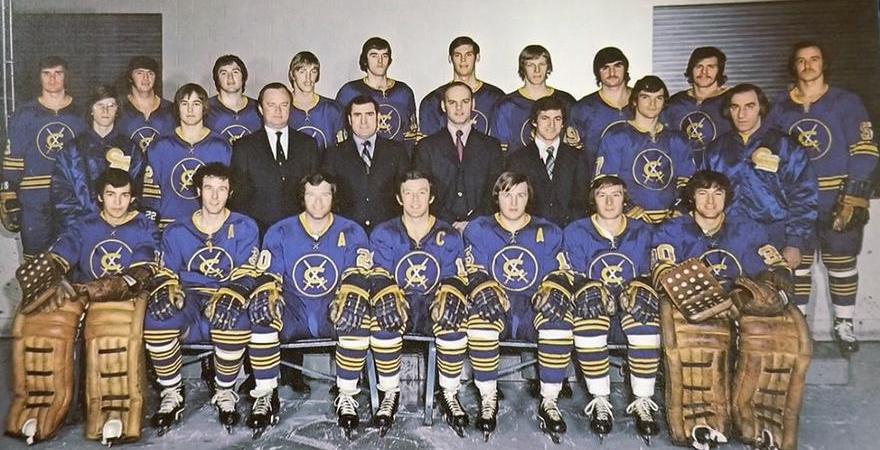
Cincinnati Swords
The Cincinnati Swords were beneficiaries and victims of expansion.
They were a team born out of the NHL expansion and eventually ceased to exist because of the WHA expansion.
During their brief tenure in the American Hockey League, the Swords could be considered successful.
In 1971, Buffalo were granted an expansion franchise in the National Hockey League (NHL), becoming the Sabres. The newest NHL team signalled the end of the city’s AHL team, the Buffalo Bisons.
The Sabres were permitted to create an AHL team to replace the Bisons and settled on Cincinnati after being denied Miami as their first choice location.
The Swords and Sabres connection was easy to make regarding the naming of Buffalo’s affiliate. That’s where the comparisons ended.
While Buffalo struggled in the NHL, Cincinnati took to life in the AHL like a duck to water.

In their inaugural campaign, the Swords posted a winning record to finish third in the Western Conference.
They duly swept Hershey in the opening round of the playoffs before falling to the Baltimore Clippers 4-2.
Cincinnati went from strength to strength in their second campaign.
They recorded 54 wins from 76 regular season games to finish atop the Western Conference before making hay in the post-season.
After sweeping Richmond in the first round, Cincinnati despatched Virginia and then Nova Scotia to hoist the Calder Cup, losing just three games.
The third and final season saw Cincatti win forty regular season games. On this occasion, they would bow out in the first round of the playoffs in five games to Hershey.
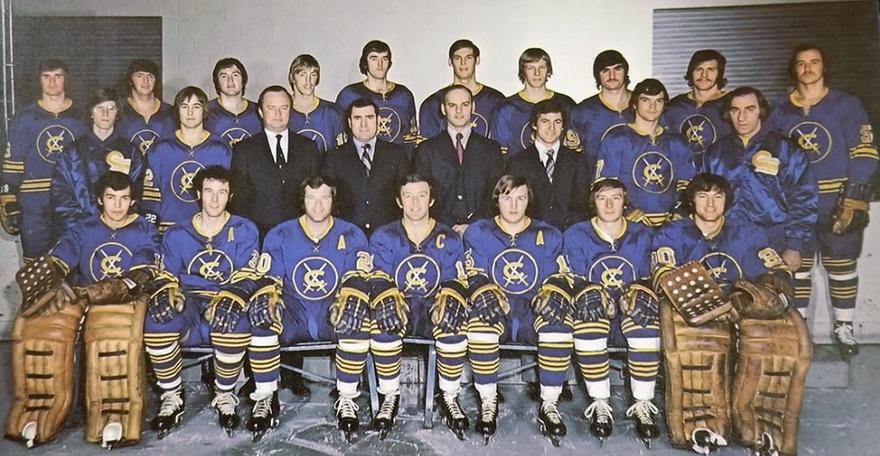
In 1974, the city of Cincinnati was granted an expansion franchise in the World Hockey Association, the Cincinnati Stingers, to begin play in 1975-76.
Despite the success and popularity of Swords in Cincinnati, Buffalo was not willing to compete with a WHA team. The Swords were thus folded and Buffalo would agree to terms with Hershey to become their affiliate the following season.
Playing in the brand new, state-of-the-art Riverfront Coliseum, the Stingers drew an average of 7,741 fans a game, doubling the attendance that the Swords had been able to achieve. The Stingers would not last long in Cincinnati, however. Having been left out of the 1979 WHA/NHL merger, the Stingers moved to the Central Hockey League for one season before disbanding in 1980.
Although in existence for only three years, the Swords broke numerous AHL records.
Most points in a season (113), most wins in a season (54), most home wins (32), most road wins (22), most points at home (65), and most points in road games (48). They outscored opponents 351-206 during their championship campaign.
Home for the Cincinnati Swords was Cincinnati Gardens, an indoor arena located in Cincinnati, Ohio, that opened in 1949. When it opened, it was the seventh-largest indoor arena in the United States, with a seating capacity of over eleven thousand.

Before being demolished in 2018, the Gardens played home to six professional hockey teams including Cincinnati Mohawks (AHL / IHL) (1949–1958), Cincinnati Wings (CPHL) (1963–1964), Cincinnati Swords (AHL) (1971–1974), Cincinnati Cyclones (ECHL / IHL) (1990–1997), Cincinnati Mighty Ducks (AHL) (1997–2005) and Cincinnati Thunder (NA3HL) (2015–2016).
Notable Players
Despite featuring in just two of the three seasons that the Swords were in existence, William Inglis is the franchise leader in goals (75), assists (93) and points (168).
Peter McNab split his rookie season between the Buffalo Sabres and their farm team.
The Vancouver native netted 34 goals and registered 73 points in forty-nine games for the Swords.
McNab would have a thirteen-season career in the NHL for Buffalo, Boston, Vancouver and New Jersey. A six-time thirty-goal scorer, he retired in 1987 with 363 goals and 450 assists through 954 games.
One player remains in the NHL to this day. Rick Dudley spent two campaigns with Cincinnati (113 points in 115 games) before graduating to the NHL. He duly defected to the WHA before ending back with the Buffalo Sabres and then the Winnipeg Jets.
After retiring in 1981, Dudley went into management and coaching and has held many roles with various organisations since.
He’s remained in the NHL since 1998 and is currently a senior advisor with the Florida Panthers.
Craig Ramsey was the 19th overall pick by Buffalo in 1971. The forward played 19 games for Cincinnati as a rookie but otherwise remained a Sabres Stalwart for his entire career.
After over a thousand games in the NHL for Buffalo, Ramsey went immediately into a coaching role with the team that drafted him.
The Ontario native would remain with Buffalo in varying roles for eight seasons.
Ramsey would also work for Florida, Dallas, Ottawa, Philadelphia, Tampa, Boston, Atlanta, Edmonton and Montreal before heading overseas.
The former Swords left-winger has been head coach of the Slovak national team since 2017 and remains in that role.
If you have enjoyed this article and would like to support my work, please consider donating at https://ko-fi.com/markukleaf or paypal.me/markukleaf
Alternatively, if you feel inclined to support me on a longer-term basis, please consider becoming a patron https://www.patreon.com/markukleaf
Thank you for considering the above, reading this article and for your continued support.
 UK Hockey Blog