
Liam Kirk shall likely begin his North American career in the AHL with Arizona’s affiliate based in Tucson.
But just what do you know about the Tucson Roadrunners?
They were created out of the necessity of many NHL teams out west to have their American League affiliate closer to home.
The Arizona Coyotes purchased the Springfield Falcons franchise and relocated them to Tucson – A move contingent on three approvals.
1) A promise to Rio Nuevo (Tucson’s downtown revitalization authority) to invest $3.2 million in arena upgrades to bring the Convention Center to professional-quality standards.
2) An agreement with the Tucson City Council for a 10-year lease with the Convention Center.
3) Approval from the AHL Board of Governors.
A name-the-team contest held in May resulted in the RoadRunners moniker.
It pays homage to the Phoenix Roadrunners, a team name in existence for over forty years in six different leagues until 2009.
There have also been five other ‘Roadrunners’ teams in Montreal, Toronto, Topeka, Santa Fe and Edmonton.

The Roadrunners call the Tucson Convention Center home with a capacity of a little under 7,000 for hockey. Discounting the most recent season, attendance has averaged around 4,150 in four years.
Tuscon began life in 2016 but struggled in their inaugural season. They posted a losing record and finished sixth of eight in the Pacific Division.

The 2017-18 campaign was a different kettle of fish for the Roadrunners.
They won 48 of sixty-eight regular-season games to clinch the divisional championship.
The playoff run ended at the second hurdle, as the Texas Stars had their number on route to reaching the Calder Cup Finals.
The 2018-19 roster was unable to replicate the success of the season before. Tucson would miss out on the playoffs by a single point despite a strong finish.
Before the pandemic halted the 2019-20 campaign, Tucson was back on track leading the Pacific Division and set for a playoff berth.
In the most recent contracted AHL season, Tucson finished rock bottom of the Pacific Division on points percentage.
In a hastily concocted playoff series that featured all seven competing teams, Tucson lost a three-game 2-1 against San Jose Barracuda.
Tucson has gone through several coaching changes despite its short time in existence.
Mark Lamb was dismissed from the Head Coaching role after the inaugural season.
Arizona’s player development coach Mike Van Ryn was handed the job next and propelled Tucson to second-season success. He then chose to leave of his own accord and was hired by the St. Louis Blues.
The Coyotes then turned to the OHL in hiring their next coach for their AHL affiliate.
Jay Varady spent two seasons as Head Coach in Tucson before being promoted to Arizona as an assistant NHL coach.
Steve Potvin was hired internally from his position as an assistant with Tucson, but it’s unclear if he will continue to be the Roadrunners Head Coach for 2021-22.
Tucson’s logo seems to divide opinion and bears a close resemblance to the old Phoenix logo and roadrunner from the famous cartoon. It has been labelled as a little too ‘cartoonish’ in some quarters. I’ll let you make your own mind up but honestly, I don’t have a strong opinion either way.

However, the Roadrunners have also been quite creative with their jersey designs and the Kachina version seems to be most popular.

There is also this most recent design which hit the right note with many fans.

So what of Liam Kirk’s chances of making the team and getting regular ice-time?
I mean, that is the question we are all asking ourselves, right?
Arizona is very much an organisation in flux and changes are occurring at every level.
Of their NHL roster from last season, only twelve players are contracted for 2021-22.
To give even greater context to the situation, of the aforementioned twelve, five will be UFA’s in 2022 and two will have RFA status.
To break down the situation in the American Hockey League let’s look at the forward group from 2020-21.
Josh Wilkins, Cameron Hebig and Michael Carcone were on loan from other clubs and as such unlikely to return.
Kevin Roy, Jérémy Grégoire and Kevin Hancock were on AHL contracts that have expired if my information is correct and as such are free agents.
Frédérik Gauthier, Blake Speers, Brayden Burke, Tyler Steenbergen and Nathan Sucese are all Restricted Free Agents heading into the summer.
I do not profess to know enough about Arizona or Tucson to take an educated stab about which of those will return. If pushed, I would think the latter four names would be retained, possibly on two-way deals.
Hudson Fasching is the lone UFA amongst the group from last year.
The 25-year-old barely played in the most recent campaign but showed beforehand that he’s a decent scorer at the AHL level.
Whether he returns is very much a coin flip but I am certain that Arizona would like him as an experienced player for their forward group in Tucson.
The remainder of the forwards from 2020-21 were prospects on entry-level contracts.
Ironically two of these three players were taken in the same draft as Liam Kirk in 2018.
Selected 65th overall, Jan Jenik is a Czech forward who only featured in North America this past season. He put up fourteen points in 29 games for Tucson whilst also scoring twice in two NHL games for Arizona.
Without knowing how highly he is thought of, it’s not beyond the realms of possibility that he is promoted to the NHL at some point next year.
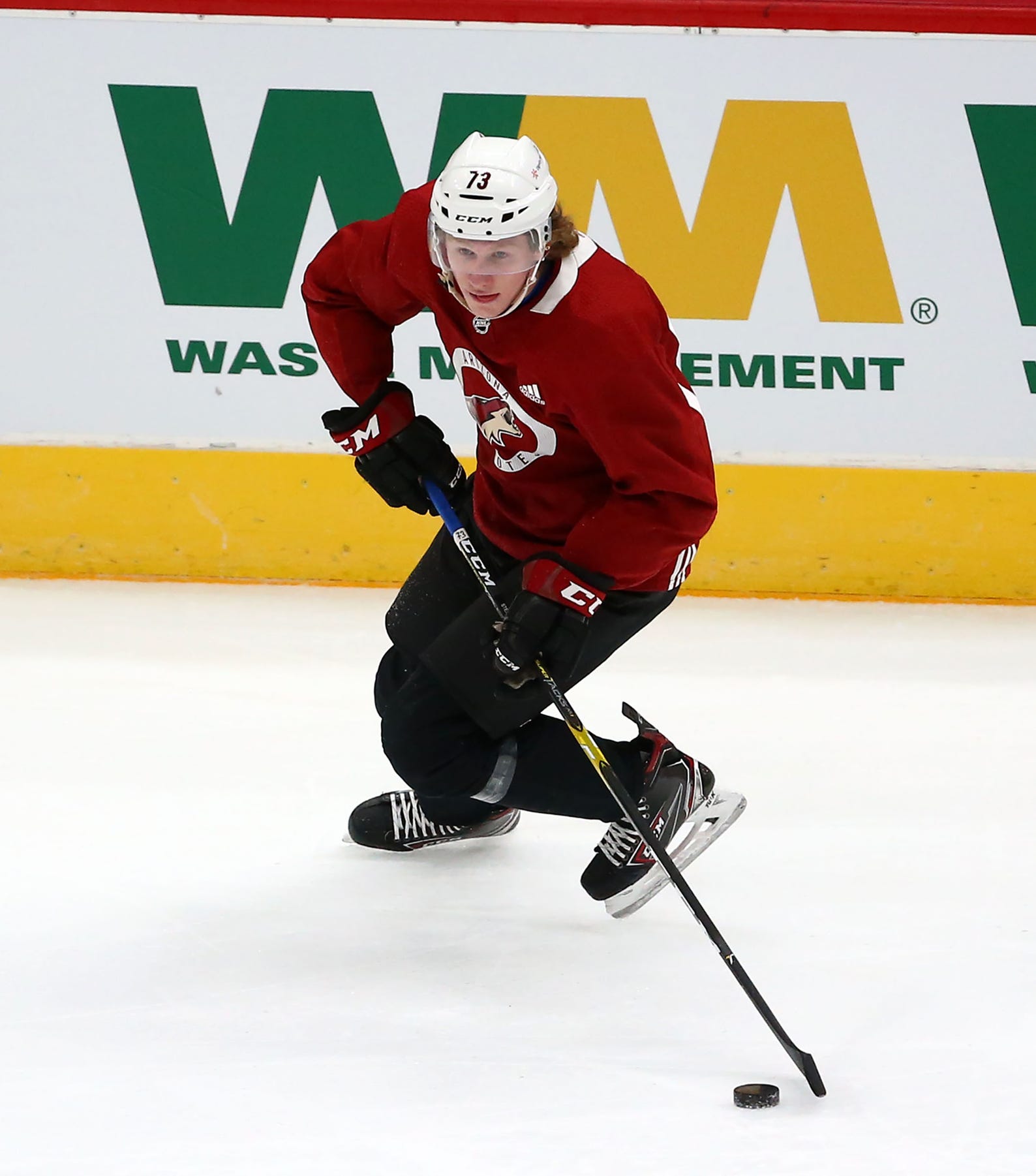
ROB SCHUMACHER/THE REPUBLIC
The other 2018 draft pick and probably a more familiar name is the fifth overall from that class, Barret Hayton.
Through two years as a professional, the 21-year-old has played almost as many games in the NHL as AHL at this point.
I expect that he’ll be afforded the chance to begin the 2021-22 campaign with Arizona.
The third is Ryan McGregor, a Toronto Maple Leafs draft pick who Arizona signed as a free agent. As an AHL rookie, he recorded eighteen points in 36, of which four were goals. I cannot foresee anything other than a sophomore season with Tucson for the former Sarnia Sting centreman.
Two other prospects who are possible additions to the Tucson roster for next season are Ben McCartney and Matias Maccelli.
McCartney is a seventh-round pick from the 2020 draft who signed an ELC this summer.
Maccelli was selected 98th overall in 2019 and has been playing in his native Finland.
With just two years left on his ELC, I would be surprised if he isn’t called upon to play in North America if the organisation has high hopes of turning the 20-year old into an NHL player.
In summary, the Arizona forward prospect pool is thin.
I can only see it bolstered if they opt to sign a prospect like John Farinacci (#76 2019) but there isn’t much other help on the way in the immediate future.
Tucson will need to sign a few veterans and fringe prospects to AHL deals to bolster their forward group this summer.
While other organisations may have had more success at the AHL level and a better track record with prospects, they also have more players fighting for the same spots and ice-time.
The situation in Tucson should afford Liam Kirk the time and opportunity to make a strong impression during his time developing in the American Hockey League.
 UK Hockey Blog